

For Schools
Bring a real space mission to your students, without adding weeks of planning to your plate.
Above the Bell delivers a premium turnkey STEM experience that combines classroom learning, real-world data, and the excitement of a high-altitude balloon mission to the edge of space.

Ready for the classroom
Complete lesson plans, student materials, and teaching guidance help teachers lead each module with confidence from day one.

Connected to learning standards
Connects science, math, engineering, and data skills to NGSS* and the core learning goals your school already prioritizes.

Professionally coordinated
Our team coordinates flight requirements, launch operations, live tracking, and recovery so your staff can stay focused on students.

Built for lasting learning
Students apply classroom concepts to a real high-altitude balloon mission, then analyze the flight data their class produced.
Program Overview
Classroom learning at every phase of a high-altitude balloon mission.
Students take active roles from preparation through launch and post-flight analysis of a payload they help choose, prepare, and send to the edge of space. We handle the professional coordination, while pacing stays flexible for your classroom.
-

Learn the Science
Students begin a sequenced 10-module curriculum, exploring the atmosphere, weather, space, and balloon flight as briefings continue through the mission.
-
Plan the Mission
Students choose a launch day, refine their mission teams, and predict the landing zone using weather and flight data.
-
Build & Test
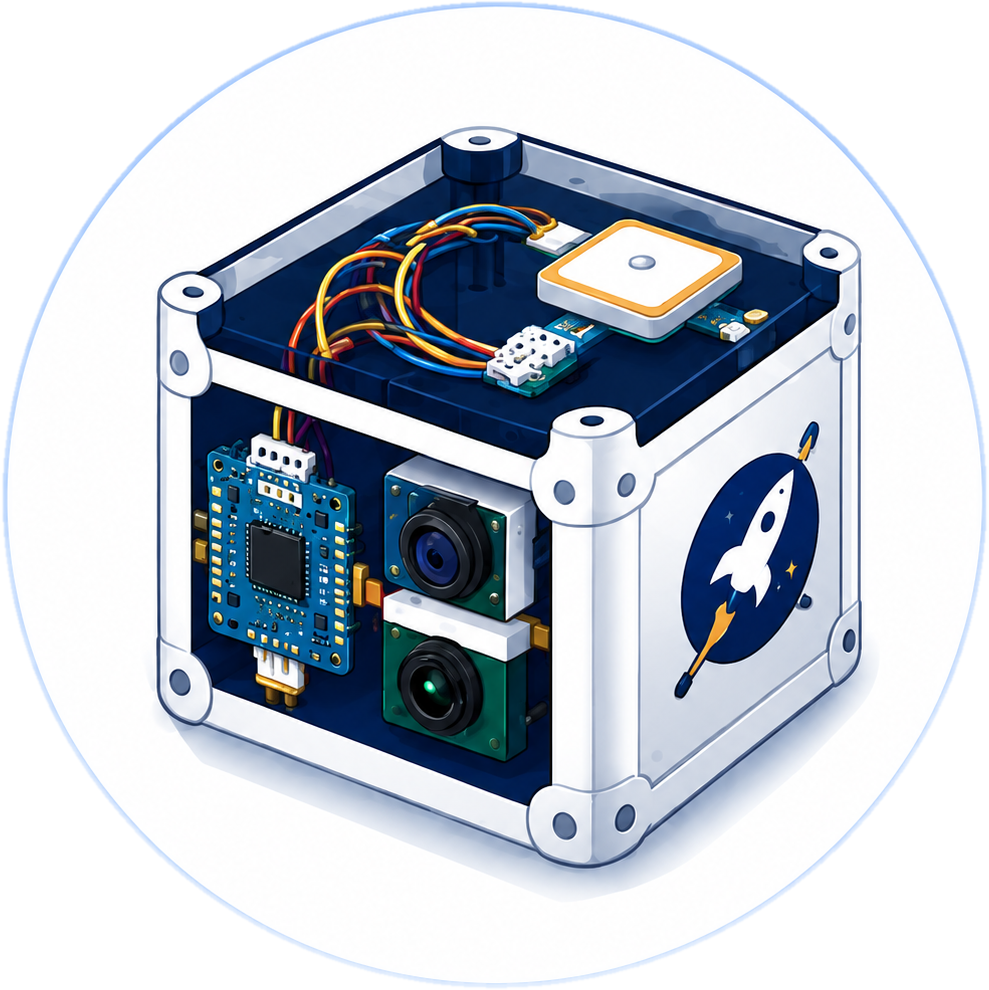
Students choose and prepare experiments for the near-space payload, then pack the kit during a week on-site before pickup.
-

Launch & Track
Students follow the flight live in Mission Control while we handle launch logistics and operations.
-

Discover
We recover the payload and return the experiments and flight data to your classroom for analysis and debrief.


What’s Included
Everything your mission needs, ready for your classroom
Curriculum, flight hardware, teacher support, and a classroom welcome kit are included with every mission.

Student mission
materials
Mission notebooks, activity pages, and design challenges for every student, in print or digital format, plus a welcome kit to kick off the mission.

Ten-module mission
curriculum
Ten customizable classroom lessons across the mission arc, each with a matching teacher guide, slides, vocabulary, and answer keys.

The mission
payload
A flight-tested payload with cameras, sensors, and GPS tracking. The kit stays on-site for a week so students can choose, prepare, and pack experiments before pickup, then returns with photos and data.

Student prediction
challenge
Students predict the landing zone before launch, then compare their guesses to the actual flight path.

Launch-day
coordination
We manage flight requirements, weather decisions, and on-site launch operations from start to finish.

Live Mission Control
dashboard
A digital classroom dashboard for live altitude, speed, and temperature, plus near-space camera snapshots on the classroom screen.

Certificates &
mission patches
Every student receives a certificate and a mission patch recognizing their role in the launch.

Ongoing teacher
support
A direct line to our team before, during, and after the mission, with quick answers when you need them.
Learning Outcomes
A mission that launches learning
Practical, hands-on instruction in atmospheric science and the ever-expanding frontier of space exploration. Students build real-world skills on a memorable mission with lasting inspiration.
- Asking scientific questions
- Weather, climate & Earth systems
- Analyzing & interpreting data
- Developing & using models
- Engineering design solutions
- Carrying out investigations
- Math & computational thinking
- Communicating evidence & findings
Built for lasting learning, and connected to the standards you already trust. Each outcome maps to NGSS* science and engineering practices, plus core ideas in weather, climate, and engineering design.

Curriculum
Ten mission briefings that build to launch day
Ten self-paced Mission Briefings (about 30–45 minutes each), in print or digital, that students can complete on their own. Optional teacher lessons are ready when you want to go deeper in class. Aligned to NGSS Earth systems, weather, and engineering design, with science practices woven through every module.

Guided by Wrigley
Wrigley, the Mission Control Captain, guides students through each Mission Briefing from kickoff through recovery and debrief.

-
1
Mission Control Academy
Students meet the balloon mission, claim a crew role (Flight Director, Weather Team, Payload Engineer, and more), and start their Mission Notebook.
-
2
Journey to the Edge of Space
Students build an altitude ladder from schoolyard to near-space so 100,000 feet feels real, not abstract.
-
3
Meet the Payload
Students explore the flying science lab (sensors, camera, GPS) and rank which measurements Mission Control needs most.
-
4
Design Like an Engineer
Students sketch a payload under real constraints: weight, cold (about −60°F), battery life, insulation, and tradeoffs.
-
5
Weather: Go or No-Go
Students read a launch forecast and complete a class go / no-go checklist. Real missions wait for safe conditions.
-
6
Lift, Burst, and Descent
Students figure out why helium lifts the balloon, why it expands and bursts near the edge of space, and what happens on the way down.
-
7
Predict the Landing Zone
With flight path physics in mind, every student enters an official landing prediction. Signature class contest moment.
-
8
Launch Day Rehearsal
Students run a countdown drill with role callouts and status checks so launch day feels organized, not chaotic.
-
9
Live Mission Control
Students monitor altitude, speed, temperature, and location in real time, then log milestones as the flight unfolds.
-
10
Recovery & Mission Debrief
Students compare predictions to the real flight, analyze the data, name contest winners, and earn certificates.

Sequenced Mission Arc
Modules build in order from preparation through launch and debrief. Student work (roles, go/no-go decisions, landing predictions, and data logs) connects directly to the real flight.

Fits Your Science Block
Guided Mission Briefings are written for independent student work. Optional teacher lessons support whole-class instruction when you want to go deeper. Schedule across 4–8 weeks, or compress around launch week.

Scales Across Grades 3–5
One core curriculum with grade-level depth options: more visual and concrete for younger students; more measurement, math, and data analysis for older students.
NGSS* Connections
Real mission. Meaningful learning.
Students apply science and engineering through mission decisions, models, tests, and explanations.
| Grade | NGSS focus | Mission connection | Evidence of learning |
|---|---|---|---|
| 3–5 | Define the challenge 3-5-ETS1-1 | Plan the Mission Set success criteria and material and weight limits for a payload protection design. | Design requirements and an explanation of constraints. |
| 3–5 | Compare solutions 3-5-ETS1-2 | Design Like an Engineer Develop two possible designs and compare how well each meets the mission requirements. | Two designs, tradeoffs, and a justified choice. |
| 3–5 | Test and improve 3-5-ETS1-3 | Build, Test & Debrief Run fair classroom tests, identify weaknesses, and revise the design. | Test results and an explanation of improvements. |
| 3 | Seasonal weather patterns 3-ESS2-1 | Weather: Go or No-Go Graph seasonal weather data to inform mission planning. | A weather graph and a supported recommendation. |
| 4 | Sending information 4-PS4-3 | Meet the Payload Create and compare ways to send coded mission messages. | Two message systems and a comparison. |
| 5 | Matter and particles 5-PS1-1 | Lift, Burst, and Descent Model the unseen particles in a gas and explain what the model shows. | A labeled model and explanation. |
Illustrative alignment. Grade-level activities can be customized to your mission plan. State-aligned standards mapping is also available.
Sample classroom challenge
Which insulation would you choose?
Compare two materials. Keep the test conditions consistent. Measure temperature changes. Recommend a design within the mission’s weight limit.
-
Run a fair test
Change only the insulation. Keep everything else the same and record the temperature change.
-
Check the weight limit
Weigh each design and confirm it stays within the mission’s limit.
-
Choose and explain
Pick a material, back it up with your results, and name the next test you would run.
Student sentence frame
“I would choose blank because my results show blank. My design stays within blank, and next I would test blank.”

Is it a go for launch?
Graph seasonal weather to find a likely launch window, then read the forecast for a specific day. Recommend a launch date and the conditions that would call for a delay.
-
Graph the season
Plot monthly temperature, wind, and precipitation to find a calm, clear window.
-
Read the forecast
Check the forecast for days in that window and recommend a launch date.
-
Set the delay rules
Name the conditions that would delay the launch and what to recheck on launch day.
Student sentence frame
“I recommend launching on blank because the forecast shows blank. We will delay if blank, and recheck blank before launch.”

Where will the payload land?
Read wind speed and direction at different altitudes. Sketch a likely flight path. Mark a landing zone and explain the evidence behind it.
-
Read the winds aloft
Compare wind speed and direction in each layer the balloon will climb through.
-
Model the path
Sketch the flight from launch to landing and mark where the payload should come down.
-
Explain the prediction
Point to the wind data behind your call and name the part you are least sure about.
Student sentence frame
“I predict a landing near blank because winds aloft show blank. My path model shows blank, and I am least sure about blank.”

Funding & Sponsorship
Built to fit your school’s size and budget
Mission pricing scales with the number of students you involve. Whether you start with one classroom or a full grade, we help you map a path that works for your school, from school and grant funding to community sponsorship.

Sized to Your Student Group
Cost scales with participation. Scope a mission for a single class, a grade level, or a larger cohort. We build a plan around your headcount, timeline, and goals.

School and Grant Funding
Many schools use STEM/STEAM grants, Title funds, PTA/PTO support, or education foundation awards. We provide documentation and materials to support your application process.

Community Sponsorship Support
Local businesses often underwrite student space missions. We help with sponsor outreach and provide ready-made sponsorship materials so your team is not starting from scratch.

Safety & Compliance
Safe, regulated flight operations from launch to recovery
Each mission is managed by a certified private pilot and conducted under FAA Part 101 requirements for unmanned free balloons. Above the Bell handles launch operations, tracking, and recovery while students participate through classroom Mission Control.
- FAA Part 101 notices, operating limits, and flight coordination
- Managed by a certified private pilot
- Adult-led launch and recovery operations
- Weather-based go/no-go decisions before every flight
- Commercial liability insurance secured before contracted program activities; certificate of insurance provided to schools before the program begins
Ready to bring a mission to your school?
Let’s work together to create an unforgettable learning experience.
Plan a School Mission Download Program Overview (PDF)
